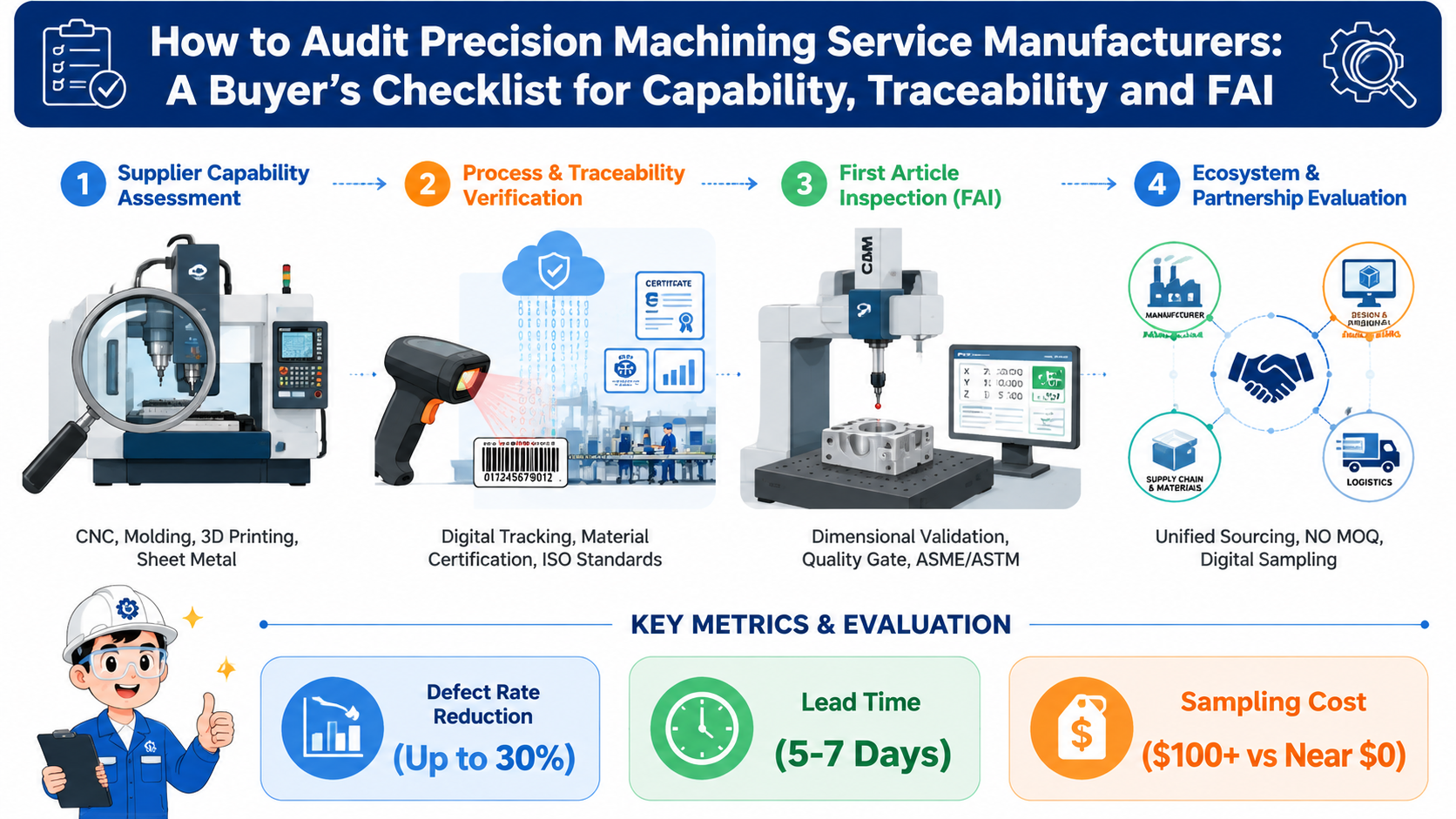
Evaluating Precision Machining Services manufacturers is no longer just about comparing price lists—it is about verifying engineering capability, production consistency, and full supply chain transparency. In today’s fragmented global sourcing environment, buyers need a structured audit system that covers CNC machining accuracy, material traceability, and First Article Inspection (FAI) readiness.
This guide breaks down exactly how to assess suppliers like OEM/ODM manufacturing systems, and how modern platforms such as integrated sourcing ecosystems help reduce risk while improving speed. You will learn how to evaluate capability, compare processes, and avoid common sourcing failures in machining and rapid prototyping supply chains.
This guide will answer critical questions like: How do you verify machining capability? What defines reliable traceability systems? And how does FAI impact production quality assurance?
What Defines a Reliable Precision Machining Manufacturer?
A reliable supplier in precision machining is not defined by machinery alone, but by the integration of engineering depth, process control, and repeatability across CNC machining, injection molding, sheet metal fabrication, and 3D printing. Leading manufacturers follow internationally recognized standards such as ISO 9001 quality management systems, ensuring consistent production workflows and audit readiness.
Industry research from McKinsey Operations Insights highlights that manufacturers with integrated digital traceability reduce defect rates by up to 30%. This is particularly important in CNC machining where micron-level deviations can impact final assembly performance.
| Capability Area | Key Audit Focus | Risk Without Verification |
|---|---|---|
| CNC Machining | Tolerance control, tool calibration, spindle precision | Dimensional instability |
| Injection Molding | Mold life cycle, material consistency | Warping, shrinkage defects |
| Sheet Metal Fabrication | Bending accuracy, laser cutting precision | Assembly mismatch |
| 3D Printing | Layer resolution, material strength | Structural weakness |
Core Capability Checklist: CNC, Molding, Sheet Metal and 3D Printing
When auditing Precision Machining Services manufacturers, buyers should evaluate multi-process capability rather than single-service specialization. Modern supply chains demand hybrid manufacturing flexibility, especially for prototyping and low-volume production.
For example, suppliers offering integrated workflows through platforms like multi-process production systems can reduce lead time by eliminating external subcontracting delays. This directly impacts production stability and cost efficiency.
| Process Type | Engineering Requirement | Buyer Benefit |
|---|---|---|
| CNC Machining | 5-axis capability, CAD/CAM integration | High precision parts for aerospace & automotive |
| Injection Molding | Thermal stability control, mold design expertise | Mass production scalability |
| Sheet Metal | Laser cutting precision, welding accuracy | Structural assemblies |
| 3D Printing | Rapid prototyping, high-resolution additive layers | Faster iteration cycles |
Traceability Systems and Quality Assurance Standards
Traceability is a non-negotiable requirement in modern precision machining. It ensures that every raw material, machining step, and inspection record is fully documented. According to NIST manufacturing standards, digital traceability significantly improves defect containment and recall efficiency in industrial production environments.
Advanced manufacturers implement barcode-based tracking systems, batch-level material certification, and real-time production monitoring. These systems are particularly critical in regulated industries such as aerospace and semiconductors, where compliance is strictly enforced.
Platforms such as aerospace manufacturing solutions demonstrate how structured traceability frameworks improve compliance and reduce operational uncertainty.
Why First Article Inspection (FAI) Determines Production Success
FAI is the validation checkpoint that ensures the first manufactured unit matches engineering specifications before mass production begins. Standards such as ASME guidelines and ASTM testing standards define measurement protocols for dimensional verification and material testing.
Without proper FAI processes, manufacturers risk scaling defects across entire production batches. This is why high-quality Precision Machining Services manufacturers integrate automated inspection tools and digital measurement systems before approving production runs.
Flowchart: The First Article Inspection (FAI) validation process in precision machining workflows
Sourcing Fragmentation vs Unified Manufacturing Systems
Traditional sourcing models rely on fragmented suppliers, leading to communication delays, inconsistent quality, and supply chain inefficiencies. Modern solutions such as the Sourcing Fragmentation Solution integrate materials, design validation, and production under one ecosystem.
Key innovations include unified sourcing hubs and smart compatibility systems that pre-validate material-to-product matching. This reduces engineering iteration cycles and prevents costly mismatches during production scaling.
| Sourcing Model | Efficiency Level | Risk Profile |
|---|---|---|
| Fragmented Suppliers | Low | High communication + quality risk |
| Unified Sourcing Hub | High | Controlled and predictable outcomes |
MOQ Flexibility and Rapid Production Advantage
One of the biggest barriers in manufacturing procurement is MOQ (Minimum Order Quantity). Traditional suppliers enforce high MOQ thresholds, limiting innovation for startups and product testing cycles. Modern systems now offer NO MOQ production, enabling flexible prototyping and market validation.
For example, advanced production networks can reduce lead time from fiber or material input to shipment within 5–7 days, while eliminating inventory risks. This is especially useful for industries testing new product-market fit before scaling.
Sampling Systems: From Physical Prototypes to 3D Digital Revolution
Sampling plays a critical role in reducing engineering uncertainty. Traditional physical samples cost over $100 per iteration, including materials and logistics. However, digital sampling technologies now enable 3D simulation with near-real visualization accuracy.
The 3D Revolution Sampling Solution reduces iteration time to 24–72 hours using high-resolution rendering and virtual prototyping. According to manufacturing digitization studies from Deloitte Insights, digital prototyping reduces development cycles by up to 60%.
| Sampling Method | Time Efficiency | Cost Level |
|---|---|---|
| Physical Sample | 7–10 days | $100+ |
| 3D Digital Sample | 24–72 hours | Near $0 |
Partner Ecosystem: OEM, Wholesale and Distributor Programs
Modern Precision Machining Services manufacturers increasingly adopt ecosystem-based collaboration models. Through OEM/ODM partnerships and wholesale programs, buyers gain access to scalable production capacity and flexible sourcing strategies.
Programs such as wholesale cooperation schemes and distributor partnerships provide incentives like commission rebates (≥12%), free entry, and full marketing support. These models are designed to reduce entry barriers while ensuring stable supply chain expansion.
You can explore more about partnership models via wholesale partnership systems or distribution onboarding programs.
Frequently Asked Questions
How does NO MOQ production help small buyers in precision machining?
NO MOQ production enables buyers to place small batch orders without large upfront commitments, allowing faster market testing and reducing inventory risk while maintaining production quality control.
What is the advantage of a unified sourcing hub in manufacturing?
A unified sourcing hub integrates materials, design validation, and production processes into a single system, improving compatibility, reducing communication delays, and increasing supply chain efficiency.
How long does sampling typically take in modern manufacturing systems?
Physical sampling usually takes 7–10 days per cycle, while advanced digital sampling systems can reduce this to 24–72 hours using high-resolution 3D modeling and virtual prototyping.
What kind of support do distributor programs provide?
Distributor programs typically include free entry, commission rebates of at least 12%, marketing support, training resources, and stable production backing to ensure long-term business growth.
Conclusion
Auditing Precision Machining Services manufacturers requires a structured approach that combines capability validation, traceability verification, and FAI inspection readiness. Buyers who adopt a systematic evaluation framework significantly reduce production risks while improving long-term supply chain stability.
Whether you are sourcing CNC components, injection molded parts, or hybrid prototypes, leveraging integrated manufacturing ecosystems ensures higher efficiency and lower operational uncertainty. Explore more solutions through advanced manufacturing platforms and build a sourcing strategy that scales with your business.