Custom CNC Machining Manufacturers Sourcing Guide: From Prototype RFQ to Production Approval
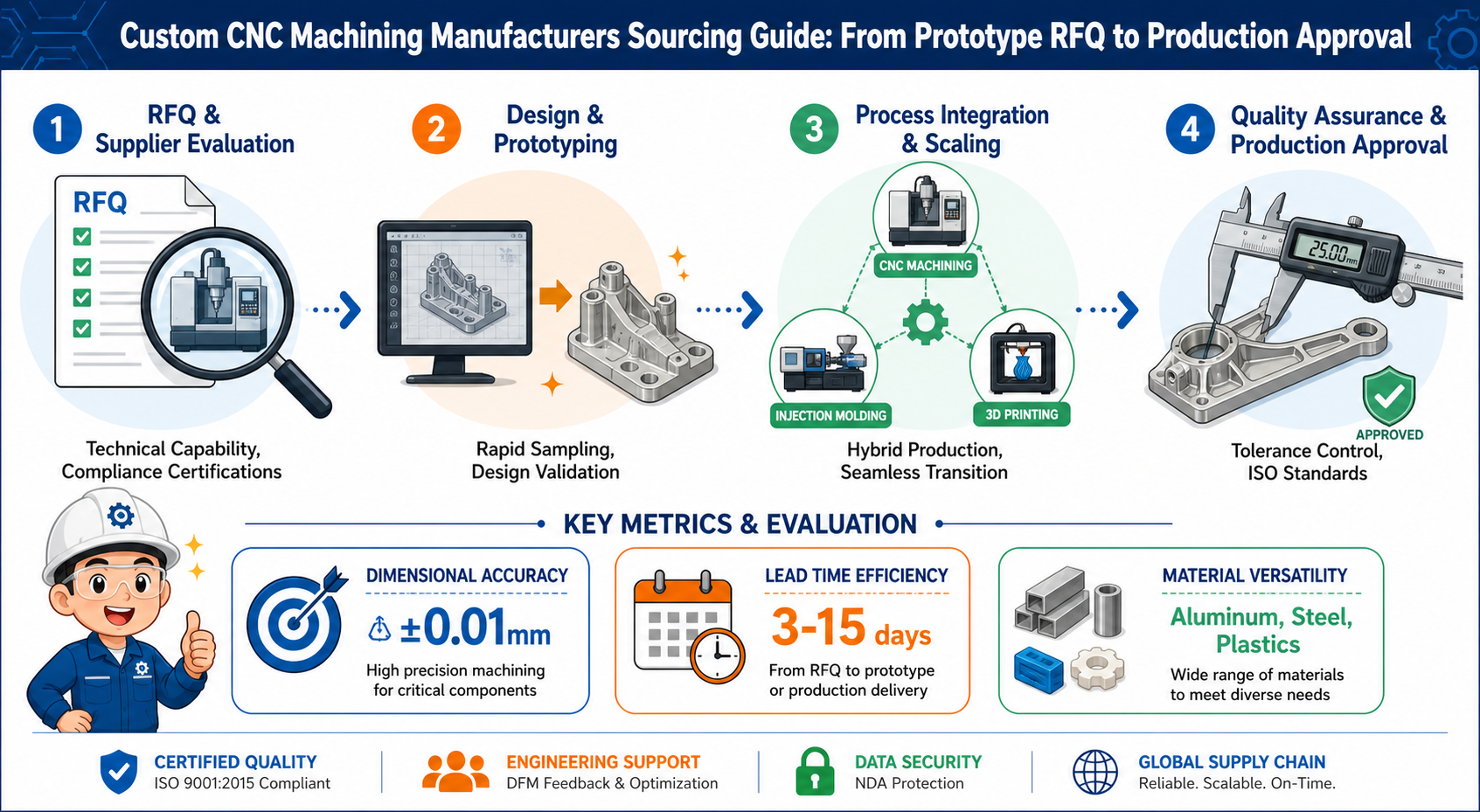
Selecting the right CNC machining manufacturers is a critical decision that directly impacts product performance, cost efficiency, and time-to-market. Whether you are developing aerospace components, semiconductor enclosures, or consumer electronics housings, understanding how to evaluate and collaborate with a reliable supplier can significantly reduce production risks.
This guide will help you navigate key decision factors such as prototyping workflows, OEM/ODM capabilities, pricing models, and quality assurance standards. For companies seeking integrated manufacturing solutions, platforms like AI Commodities product ecosystem and their OEM/ODM manufacturing services offer structured pathways from concept to mass production. This guide will answer critical questions like how to evaluate CNC suppliers, how to reduce MOQ constraints, and how to accelerate prototyping cycles for production approval.
Understanding CNC Machining Manufacturers and Their Service Scope
CNC machining manufacturers provide subtractive precision manufacturing services that transform digital CAD models into physical parts using milling, turning, and multi-axis machining technologies. Modern suppliers are no longer limited to machining alone; they often integrate injection molding, sheet metal fabrication, and 3D printing into unified production systems to support end-to-end product development.
For example, integrated manufacturers such as AI Commodities expand their capabilities into aerospace, clean energy, and semiconductor industries, ensuring scalable production across prototyping and mass manufacturing stages. This multi-process ecosystem reduces fragmentation and improves consistency across product lifecycles.
Key Evaluation Criteria for CNC Machining Suppliers
When comparing CNC machining manufacturers, procurement teams typically evaluate technical capability, production stability, and compliance certifications. High-performance suppliers must demonstrate tight tolerance control, material versatility, and scalable throughput without compromising quality consistency.
| Evaluation Criteria | Why It Matters | Industry Benchmark |
|---|---|---|
| Dimensional Accuracy | Ensures part compatibility and assembly precision | ±0.01mm to ±0.05mm depending on application |
| Material Capability | Supports diverse applications from aerospace to electronics | Aluminum, stainless steel, engineering plastics |
| Lead Time Efficiency | Impacts product launch speed and iteration cycles | 3–15 days for prototyping batches |
| Compliance Standards | Ensures global regulatory acceptance | ISO 9001, RoHS, REACH |
According to ISO quality management standards and ASME engineering guidelines, suppliers with standardized process control systems significantly reduce defect rates and improve long-term reliability.
Manufacturing Capabilities: CNC, Injection Molding, Sheet Metal, and 3D Printing
Advanced CNC machining manufacturers increasingly operate as hybrid production hubs. Beyond CNC machining, they integrate injection molding for high-volume plastic parts, sheet metal fabrication for structural components, and 3D printing for rapid prototyping and design validation.
This integrated approach allows engineering teams to transition seamlessly from prototype to production without switching suppliers. It also improves cost predictability and reduces communication gaps between different manufacturing stages.
| Process Type | Best Use Case | Production Advantage |
|---|---|---|
| CNC Machining | High-precision metal & plastic parts | High accuracy, low tolerance deviation |
| Injection Molding | Mass production plastic components | Low unit cost at scale |
| Sheet Metal Fabrication | Structural enclosures & frames | High durability and scalability |
| 3D Printing | Prototyping and design validation | Fast iteration cycles |
Rapid Prototyping and Sampling Solutions
Speed is a decisive factor in modern manufacturing. AI-driven suppliers often provide structured sampling systems such as 3D Revolution digital prototyping and standard physical sampling workflows. These solutions help engineers validate designs before committing to mass production.
For example, AI Commodities offers rapid sampling with 24–72 hour digital turnaround and cost-efficient validation cycles, enabling faster engineering feedback loops and reduced development risk.
OEM/ODM and Wholesale Partnership Models
OEM and ODM collaboration models are essential for brands seeking scalable manufacturing partnerships. Through structured programs like Wholesale Partner Program and Agent Cooperation System, businesses can access factory-direct pricing, design support, and supply chain stability.
These models are particularly beneficial for distributors and B2B buyers who require flexible SKU management, small batch validation, and long-term procurement scalability.
Industry Applications Across High-Tech Sectors

CNC machining manufacturers play a critical role in industries requiring high precision and reliability. Key sectors include aerospace manufacturing, semiconductor equipment, clean energy systems, and new energy storage solutions. These industries demand strict tolerances and consistent material performance under extreme conditions.
For instance, AI Commodities supports applications in aerospace manufacturing systems and semiconductor industry solutions, ensuring production reliability across mission-critical environments.
Cost, MOQ, and Lead Time Optimization Strategies
One of the most common challenges in manufacturing sourcing is balancing MOQ constraints with cost efficiency. Modern suppliers address this through flexible production systems that eliminate traditional inventory risks and support low-volume validation.
AI Commodities’ NO MOQ production model enables small-batch testing while maintaining scalable mass production readiness. Combined with rapid supply chain clearance (5–7 day turnaround for certain workflows), this significantly improves cash flow efficiency for growing businesses.
Quality Assurance and Compliance Standards
Quality assurance is central to CNC machining manufacturers, especially for industries such as medical devices, automotive electronics, and aerospace systems. Leading suppliers adhere to global compliance frameworks including RoHS, REACH, UL, and ISO certifications to ensure product safety and environmental responsibility.
According to NIST manufacturing research, standardized metrology and process validation reduce production variability and enhance long-term reliability across global supply chains.
Frequently Asked Questions
How do rapid sampling solutions improve CNC machining development cycles?
Rapid sampling systems such as 3D digital prototyping and physical sample workflows reduce iteration time significantly. AI Commodities supports both digital and physical sampling methods, enabling faster validation and reduced development costs while improving design accuracy before mass production.
What advantages does a no MOQ CNC manufacturing model provide?
A no MOQ system allows businesses to test markets with minimal inventory risk. It supports flexible production scaling and is particularly useful for startups and OEM buyers validating new product lines before committing to large-scale manufacturing.
How does OEM/ODM cooperation support long-term manufacturing partnerships?
OEM/ODM models provide integrated design, production, and supply chain services. AI Commodities offers structured OEM/ODM support with design collaboration, production scalability, and distribution assistance to help businesses expand efficiently.
What industries benefit most from CNC machining manufacturers?
Industries such as aerospace, semiconductor, clean technology, and new energy systems benefit most due to their need for precision, durability, and compliance. Integrated manufacturing ensures stable performance in high-stress environments.
Conclusion
Choosing the right CNC machining manufacturers is not just a procurement decision—it is a strategic partnership that affects product quality, speed to market, and long-term scalability. By leveraging integrated manufacturing ecosystems, OEM/ODM partnerships, and advanced sampling systems, businesses can significantly improve operational efficiency and innovation speed.
Explore more solutions through our company profile or browse integrated offerings on the product platform to accelerate your next manufacturing project.
For global sourcing teams seeking reliable CNC machining manufacturers, now is the time to move from fragmented suppliers to integrated production ecosystems that ensure quality, speed, and scalability.
Authoritative references: SME Manufacturing Association | Manufacturing.net | Thomasnet Industrial Directory
Get in touch with us!
and everything in between, our team of experts are always ready to assist.